
The Galapagos: Evolution In Action
- Mar 20
- 7 min read

The Galapagos Islands are unlike any other place on earth. Located roughly 600 miles off the coast of Ecuador in the Pacific Ocean, this volcanic archipelago of 18 major islands is the place where Charles Darwin confirmed his theory of natural selection and evolution (in 1835). Today, it's one of the most tightly regulated, deeply studied, and utterly jaw-dropping places a human being can visit — and getting there is a genuine adventure, start to finish.
Who should visit (and why):
The Galápagos is one of those rare destinations that rewards almost every type of traveler that embraces the outdoors. It is especially well-suited for:
Science enthusiasts -- Walking the ground that inspired the theory of evolution, guided by naturalists who know every species by name is genuinely thrilling.
Nature and wildlife lovers -- The density and fearlessness of wildlife here is absolutely unmatched anywhere on the planet.
Divers and snorkelers -- The underwater world in the Galapagos rivals the land. Swimming with sea turtles, hammerhead sharks, rays, and penguins is not to be forgotten.
Photographers -- Wildlife that poses for you, volcanic moonscapes, and lovely seascapes -- what more could you want?!
Families with curious kids -- The Galapagos is a living classroom. Children can see baby sea lions playing in tide pools, and animal species that have adapted to thrive only on certain islands will ensure the theory of evolution is never questioned.
Adventurous travelers -- Climbing up volcanic structures, hiking, snorkeling, and beachcombing ensure memories that will last a lifetime.
One important note here: The Galapagos is not a beach-resort type of destination. You won't find a nightlife to speak of or any beach bars.
The Guides (The Naturalists)
One of the most important things to understand about a Galápagos trip is that you cannot explore the national park without a certified naturalist guide. This isn't just come bureaucratic gimmick, this is truly one of the best things about a Galapagos experience.
Galápagos naturalist guides are certified by the Ecuadorian government after years of training in biology, geology, oceanography, and ecology. There are three levels: Level 1 (Spanish-only, local islands), Level 2 (bilingual, all islands), and Level 3 (Master Naturalists, highly specialized). The best guides are extraordinary naturalists who've spent their entire careers on these islands.
A great guide will spot a hawk you'd walk right past, identify a finch species by its 4-second song, explain why that particular lava formation tells a story about a 500,000-year-old eruption, and -- perhaps most importantly -- help you understand the deep fragility and ongoing conservation battles of this ecosystem there. They are the difference between a vacation and an exploration.
Geology & Landscape




The Galápagos are a volcanic hotspot archipelago. The islands were formed (and continue to be formed) as the Nazca tectonic plate slowly drifts over a stationary column of superheated mantle rock. The oldest islands are to the east; the youngest (and still actively erupting) are to the west.
Isabela and Fernandina islands have seen eruptions in recent decades. Wolf Volcano on Isabela, the archipelago's highest peak at 5,600 feet, last erupted in 2022. This isn't ancient geological history — it's happening now, beneath your feet.
Lava Fields (Pahoehoe & Aa)
The two distinct lava types we learned about in science class define the landscape. Pahoehoe (pronounced "pa-hoy-hoy") is smooth and ropy, while Aa (pronounced "ah-ah") is jagged, sharp-edged rubble that can destroy your hiking boots. Both are black and utterly otherworldly.
Lava Tubes
Lava tubes are underground tunnels carved by lava flows that hardened on the outside while lava was still flowing within them. Santa Cruz has impressive lava tubes you can walk through — some up to 60 feet in diameter!
Colored Beaches
Different islands offer beaches in different colors -- white (made from coral), black (made from lava), red (made from iron-rich sediment), and even green (made from olivine crystals from eroded volcanic rock). The red-sand beach at Rabida and the green beach at Espinoza Point are especially surreal.
Vegetation Zones
Each island has distinct elevation zones: barren lava shore → arid cactus scrubland → transitional zone → lush highlands cloud forest. A single hike can take you through multiple ecosystems. The highlands of Santa Cruz feel positively Jurassic — misty, green, and ancient.
The Humboldt Effect
Cold upwelling water from the south means the Galápagos Islands are cooler and more nutrient-rich than you'd expect at the equator. This biological quirk is precisely why species like penguins and fur seals ended up here, far from their Antarctic origins, and why the marine life diversity is staggering.
Let's Talk About The Wildlife
The defining characteristic of Galápagos wildlife is fearlessness. Having evolved without natural land predators, the animals here never developed a flight response to large mammals — including humans. Nationally trained and highly regulated rangers enforce a 6-foot minimum distance to ensure that fragile trust is not broken. An important note: if there are any animal species you especially want to see, be sure to do your homework as they are not all in evidence across all the islands!










Marine Iguana
The world's only sea-going lizard. They dive into cold Pacific waters to graze on algae, then pile onto lava rocks in great black heaps to warm themselves — occasionally sneezing salt water! Darwin called them "imps of darkness."
Blue-Footed Booby
These are the tourists' star of the Galápagos. Males court females by lifting their impossibly turquoise feet in a high-stepping dance. The bluer the feet, the healthier the bird — it's a genuine indicator of fitness.
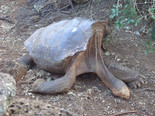
Galápagos Giant Tortoise
The archipelago's namesake animal (galápa means "saddle" in Spanish, describing their shells). They can live over 150 years, weigh up to 550 lbs, and move with the magnificently unhurried confidence of a creature that has never needed to rush for anything.
Galápagos Sea Lion
Adorable sea lion pups often approach snorkelers and tourists on the beach out of sheer curiosity. Bulls bark at tourists who wander too close to their beach territory. Juveniles use park benches as napping spots. They are completely at home in the human world and couldn't care less that you're staring and gaping at them.
Galápagos Penguin
The only penguin species found north of the equator. They're small, fast, and amazing to encounter. Swimming alongside them in the colder western waters near Fernandina is one of the great wildlife experiences on Earth.
Waved Albatross
Nearly the entire global population — around 35,000 pairs — nests on Española Island. Watching a pair perform their elaborate bill-clacking, sky-pointing courtship dance is a seasonal highlight: visit April–December.
Galápagos Shark & Hammerheads
Sharks are everywhere in Galapagos waters. Whitetips rest on the sandy bottom. Hammerheads school in shimmering hundreds at Darwin Island. Whale sharks pass through on seasonal migrations. The waters here are a rare place where apex predators still roam in abundance.
Darwin's Finches (18 species, endemic)
These are small, unremarkable-looking birds that changed the course of scientific history. Darwin noticed that finch beak shapes varied by island and diet — a key piece of evidence for natural selection. Today, researchers continue studying them as a living model of ongoing evolution.
Flightless Cormorant
The only cormorant in the world that can't fly. With no land predators and abundant fish, wings became metabolically expensive and evolution shrank them. It holds those stubby, vestigial wings out to dry after diving — a poignant reminder that evolution is always editing.
The Ins & Outs of Traveling to the Galapagos
Visiting the Galápagos requires a bit more planning than your average vacation, which is part of what keeps it special. Ecuador controls access tightly, and that's a very good thing.
When to Go: The Galápagos is genuinely a year-round destination, but seasons matter. December–May brings warm, calm seas and hatching sea turtles. June–November brings cooler, choppier water (better for diving) and spectacular wildlife activity like penguin breeding and albatross dancing. There's no bad time, but be sure to do your homework.
Getting There: The start to any Galapagos journey starts with a flight into Quito or Guayaquil, Ecuador, followed by a connection on a domestic flight to either Baltra (near Santa Cruz) or San Cristóbal. Flight time is about 2 hours. All visitors pay a $200 Galápagos National Park entrance fee and a $20 Transit Control Card — collected at the airport. Pack everything, because you can't buy it once you're there.
How to visit -- cruising
The gold standard of how to make the most of your time in the Galapagos is by taking a cruise. This allows you to sleep onboard and wake up at a new island each morning, reaching sites that day-trippers can never access. Itineraries are carefully designed to hit a wide range of islands with small groups (16–100 passengers). Naturalist guides are on hand 24/7. If you can swing the cost ($3,000–$10,000+ per person/ week depending on the cruise and ship you take), this is definitely the way to go.
How to visit -- Island-based day trips
If cruising won't work for you, you can stay on Santa Cruz or San Cristóbal and take day-boat excursions. This is a more affordable option, and lets you experience real island towns. But, you will miss the outer islands where wildlife is most concentrated and pristine. At (typically) $1,500–$3,000 per person/ week, this is a solid option for budget travelers or those who get seasick.
Some Practical Tips
Book your cruise 6–12 months ahead — the best boats fill up fast
Bring reef-safe, mineral sunscreen only (chemical sunscreens are banned)
Biosecurity is serious: footwear is washed between islands to prevent species transfer
Pack a dry bag — Zodiac wet landings are part of every itinerary
A waterproof camera or GoPro is essential
Seasickness patches are a good idea to get if cruising in open water is new to you
Tipping: excellent guides deserve a tip, and they make a big difference
Phone signal is spotty, FYI
Visit before it is too late!
Not to alarm you, but the Galápagos has faced — and continues to face — serious threats. Introduced species (rats, cats, goats, fire ants) devastated native populations for centuries. Illegal fishing continues to pressure shark and sea cucumber populations. Climate change is warming and acidifying the waters that nourish the entire food system.
But the conservation story is also worth mentioning. The Galápagos National Park Service, the Charles Darwin Foundation, and organizations like Island Conservation have eliminated introduced goats from entire islands, allowing native vegetation to recover. Giant tortoise populations have rebounded from near-extinction. The marine reserve, established in 1998, protects 51,000 square miles of ocean — one of the largest protected marine areas in the world.
When you visit, you are part of this story. Regulated tourism generates the revenue -- and the political will -- to maintain this protection. Every responsible traveler who leaves only footprints helps make the case that this place is worth protecting forever. The Galápagos Islands don't need to be saved from tourists; they needs tourists who understand what they're standing in the middle of — and come home as ambassadors.


Comments